Press
Facts, figures and assets
Everything on this page is checkable against the live site. If you need a figure that is not here, or want the reasoning behind one that is, the address below is answered by a person.
In one paragraph
What LegitSonar is
LegitSonar assesses whether a website can be trusted, using technical signals — how old the domain is, who issued its certificate, whether an owner is identifiable, what its infrastructure looks like — and publishes a score out of 100 with the reasoning behind it. It holds assessments for 607,294 domains and can analyse any other on demand. It is free, carries no advertising, requires no account, and takes no money from the sites it assesses.
Figures
Current, and recomputed hourly
These are read from the live database when this page is served, so a number quoted here will match the statistics page at the moment you read it. Please date any figure you publish.
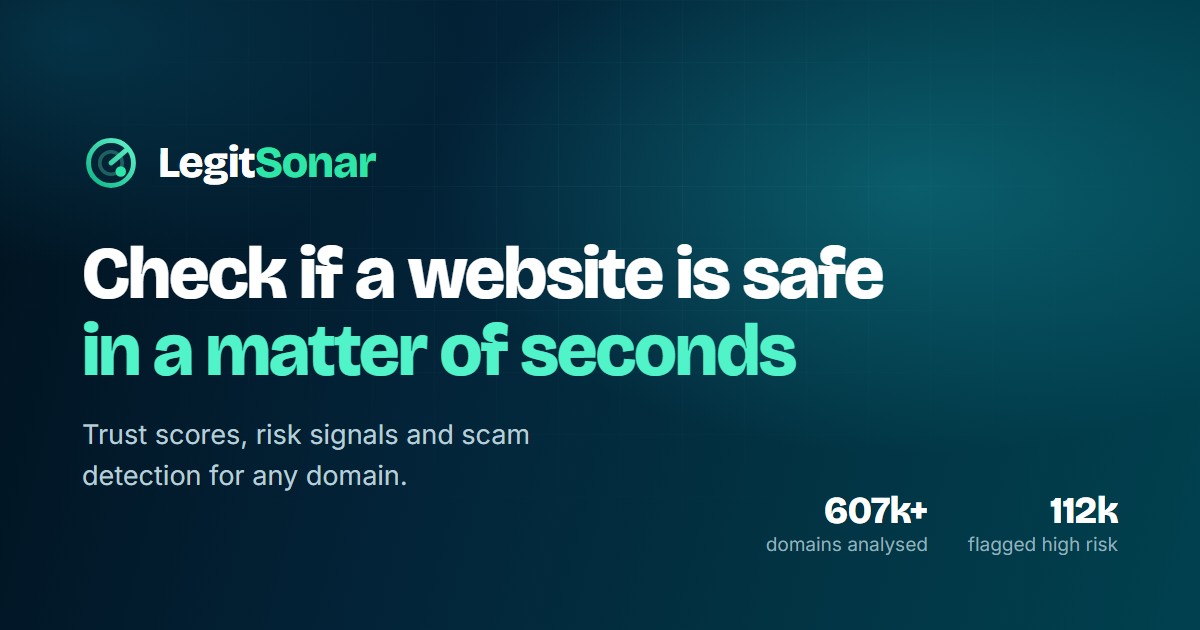
607,294
Domains assessed
Across 753 address endings.
112,361
In the bottom band
19% of everything on file.
341,317
Rated trustworthy
Score of 60 or above.
62.9
Average score
Which describes almost no individual domain — the distribution is bimodal.
Brand assets
The mark, and how to use it
The logo is an SVG and scales to anything. Please keep the wordmark's two-tone treatment — "Legit" in the dark green, "Sonar" in the light — and leave clear space of at least the height of the mark on every side.

Colours
If you are writing about us
Three things we would ask you to get right
A score is an opinion, not a certification
It is produced by software from technical signals. Describing LegitSonar as "certifying" or "verifying" a site overstates what it does, and we would rather be described accurately than favourably.
Reports are snapshots
Every report carries its analysis date. If you cite one, cite the date too — a site can be sold or compromised the following day, and a quoted score without a date becomes wrong without anyone noticing.
No company stands behind it
LegitSonar is an independent project, not a business. There is no team to interview and no funding to report. The legal notice sets out the publishing position.
The method is public
What goes into a score, and what it cannot know, is written out on the methodology page — including the parts that are derived rather than measured.